
In Nevada, delaying solar by two years (moving your timeline from 2026 to 2028) isn’t just about “missing out” on free energy; it’s a gamble against rising utility rates and shifting policy.
Based on current 2026 data, here is the breakdown of what that two-year delay could cost you.
1. Lost Savings (The “Sun Tax”)
By not having solar for 24 months, you continue to pay your full utility bill.
* Average Annual Bill: The average Nevada household spends roughly $2,100 per year on electricity ($175/month).
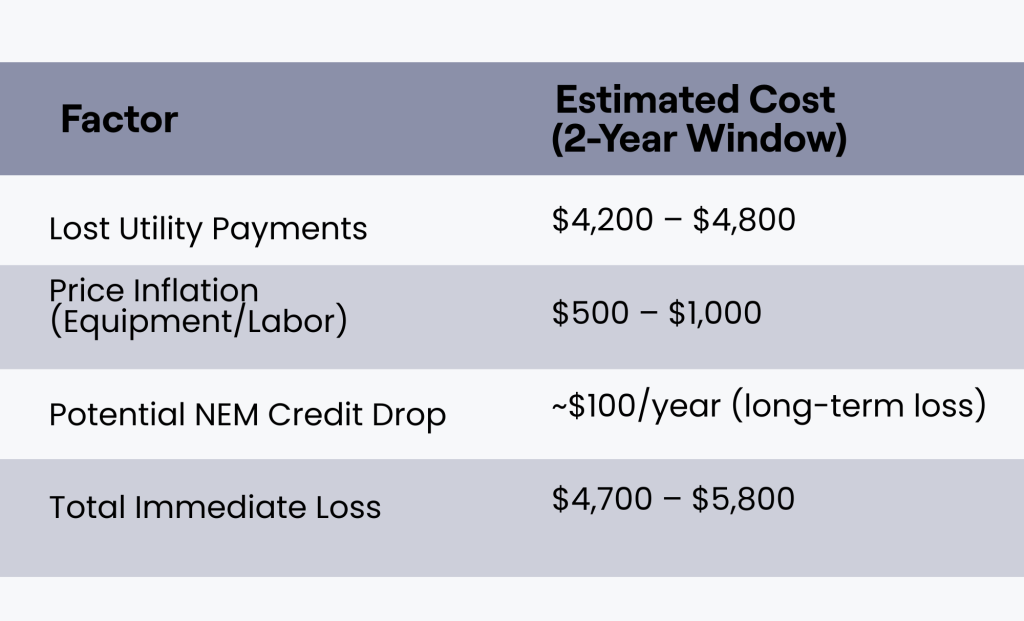
* Two-Year Cost: You will hand over approximately $4,200 to NV Energy that could have gone toward paying off your solar asset.
2. Rising Utility Rates
Electricity rates are not static. While 2026 rates sit around $0.15/kWh, historical trends and forecasts suggest annual increases of 2%–5%.
* If rates jump 15% over the next two years (a common occurrence during grid modernizations), your “missed savings” grows from $4,200 to nearly $4,800.
* The Demand Charge: Starting April 2026, NV Energy is introducing a residential demand charge. Waiting means you miss the chance to “grandfather” into older billing structures or gain the immediate benefit of using solar/batteries to shave those new peak charges.
3. Net Metering Atrophy
Nevada uses a tiered Net Metering (NEM) system. Under current rules (Tranche 4), you get credited at 75% of the retail rate for excess energy you send back.
* The Risk: These tiers are based on total state solar capacity. If Nevada hits its next capacity benchmark while you are waiting, the credit rate could drop (e.g., to 68% or lower).
* Lock-in Advantage: Once you sign up, your rate is typically locked for 20 years. Delaying risks locking in at a lower, less favorable percentage.
4. Opportunity Cost & Financing
* Asset Equity: Solar panels typically pay for themselves in 8–10 years in Nevada. A two-year delay pushes your “break-even point” two years further into the future (e.g., from 2034 to 2036).
Total Estimated Impact of a 2-Year Delay
Pro Tip: In Nevada’s high-heat climate, the introduction of demand charges in 2026 makes pairing solar with a battery more valuable than ever. Waiting until 2028 might mean paying more for a battery that you could have used to save money starting today.